
A sale email makes factual claims about prices, deadlines, gifts and customer reviews. Readers rely on those claims, and consumer law requires them to be true and not misleading.
Regulators are checking sale claims this season. Before Black Friday, the Australian regulator said on 10 November 2026: "For the first time, this year’s sweep will examine retailers’ advertising practices across multiple channels, including websites, emails, and social media." In October, the UK's Competition and Markets Authority (CMA) fined Wayfair £4.8 million for false time-limited offers. On 11 November, the European Commission proposed a Digital Fairness Act.
This guide explains the rules behind common claims and where to check them in AcelleMail. Our examples use Brightside Coffee, an invented shop that sells coffee beans and grinders.
This guide covers:
- Two layers of rules for a sale email
- "Was" prices and percentage discounts
- Deadlines, countdowns and "while stocks last"
- "Free" gifts and the conditions behind them
- Reviews, star ratings and other social proof
- Green claims: "eco-friendly" and "climate neutral"
- What may change: the EU's Digital Fairness Act proposal
- Your sale emails in AcelleMail
It ends with the most common mistakes and a one-screen summary.
Not legal advice. This guide describes the rules in general terms and links to the official texts. Laws differ by country and change over time. Before you send a campaign that depends on them, check the rules that apply to your business or ask a lawyer.
1. Two layers of rules for a sale email
The first layer covers consent, unsubscribe links, your identity, and honest From and subject lines. Email Consent Explained, section 5, and Email Subject Lines Explained, section 5, explain these requirements.
The advertising label is part of this layer:
- In the US, CAN-SPAM requires "clear and conspicuous identification that the message is an advertisement or solicitation". This label is not needed if the reader expressly agreed beforehand to receive the email, which the law calls prior affirmative consent. Neither the Act nor the FTC requires "ADV" in the subject line. 15 U.S.C. 7704
- The UK's CAP Code, the advertising code that the Advertising Standards Authority (ASA) enforces, says: "Marketing communications must be obviously identifiable as such." Rule 2.2 says unsolicited marketing email must be recognisable as marketing before anyone opens it. Your From name and subject line should make that clear. CAP Code section 2
- The EU's e-Commerce Directive requires that "the commercial communication shall be clearly identifiable as such". Article 6
The second layer covers the offer and applies to emails as well as websites.
The EU's Unfair Commercial Practices Directive (UCPD) covers marketing connected with selling products to consumers. An email can give a misleading overall impression, even when each fact in it is correct. Annex I of the directive lists the EU's banned practices, which are unfair in all circumstances. Directive 2005/29/EC
The UK's Digital Markets, Competition and Consumers Act 2024 has its own list in Schedule 20. This list has been in effect since 6 April 2025. The CMA can fine a business up to 10% of its worldwide turnover, meaning its total sales, or £300,000 if that is higher. Schedule 20, CMA enforcement powers
The US has FTC guides on pricing and "free" offers, a reviews rule and endorsement guides. Some states also have email laws.
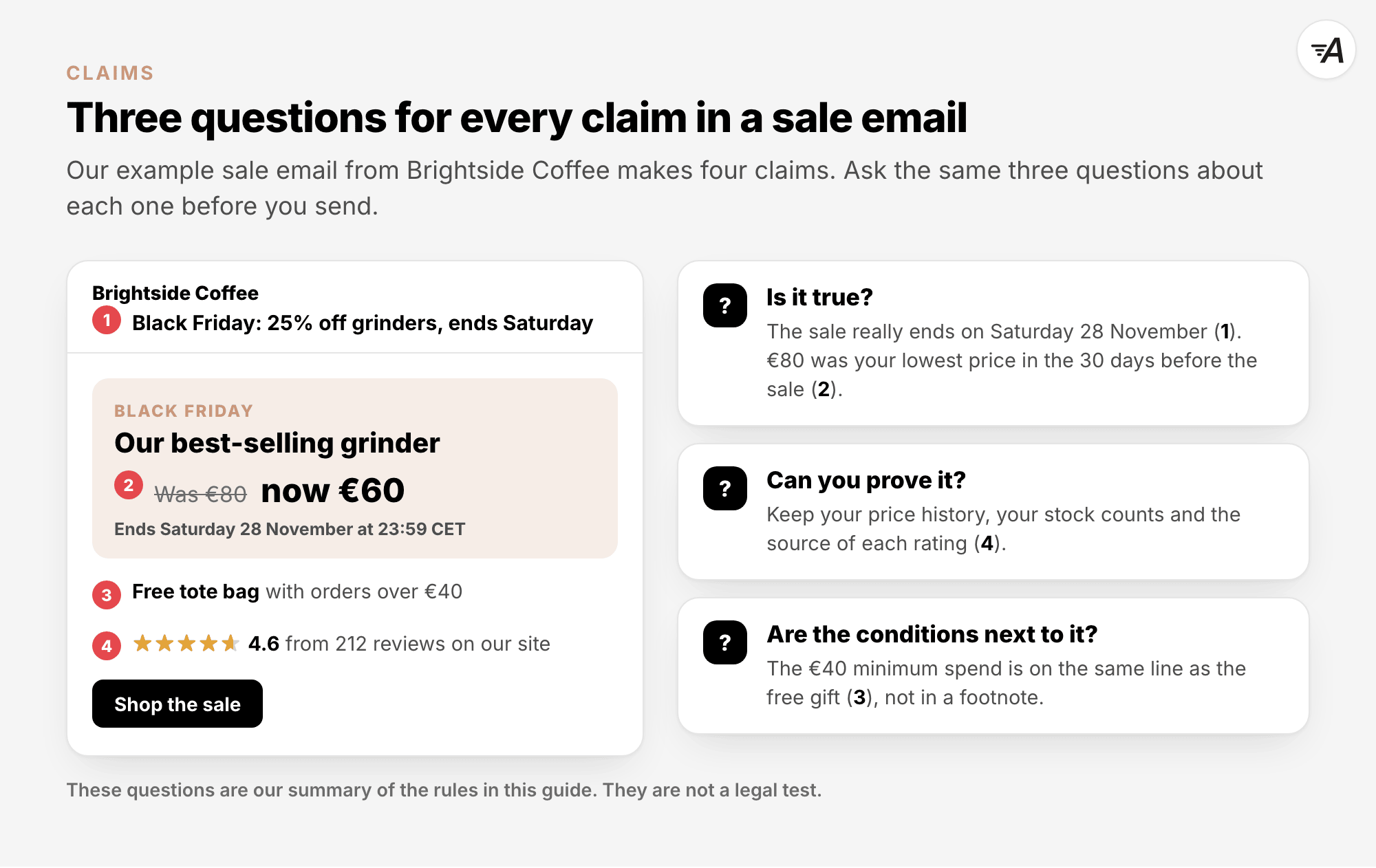
We suggest using these three questions to check every claim. They summarise this guide and are not a legal test:
- Is it true? Check the whole claim, including the impression it gives.
- Can you prove it? Keep price histories, stock records and the sources of ratings.
- Are the conditions next to it? Make purchase requirements and exclusions clear beside the offer.
The diagram shows how these questions apply to claims in Brightside Coffee's sale email.
2. "Was" prices and percentage discounts
For goods in the EU, Article 6a of the Price Indication Directive requires price reduction announcements to show a prior price, which is your lowest price over at least the 30 days before the reduction. Article 6a, added by Directive 2019/2161, defines it this way: "The prior price means the lowest price applied by the trader during a period of time not shorter than 30 days prior to the application of the price reduction." These measures have applied since 28 May 2022. Directive 2019/2161
This rule covers goods. It does not apply to services or digital content, such as online courses or software downloads. However, misleading price comparisons are still banned under the UCPD. Commission guidance
Percentage reductions must also use the prior price, as the Court of Justice of the EU confirmed in Aldi Süd on 26 September 2024. The same applies when a price reduction is announced with a promotional claim that stresses how good the price is, such as a "price highlight". Case C-330/23
The Commission's guidance specifically covers Black Friday offers that give the impression of a price reduction. A general email saying "20% off everything" does not need to show every prior price. Your shop must still show each product's prior price at the point of sale. If an email shows an individual product's reduction, the email must show that product's prior price, and any percentage must be based on it. Commission guidance
Earlier sale prices still count if the price goes back up between sales. A country may allow one exception: in a single sale whose discount grows step by step without a break, the "was" price can stay the price before the sale began.
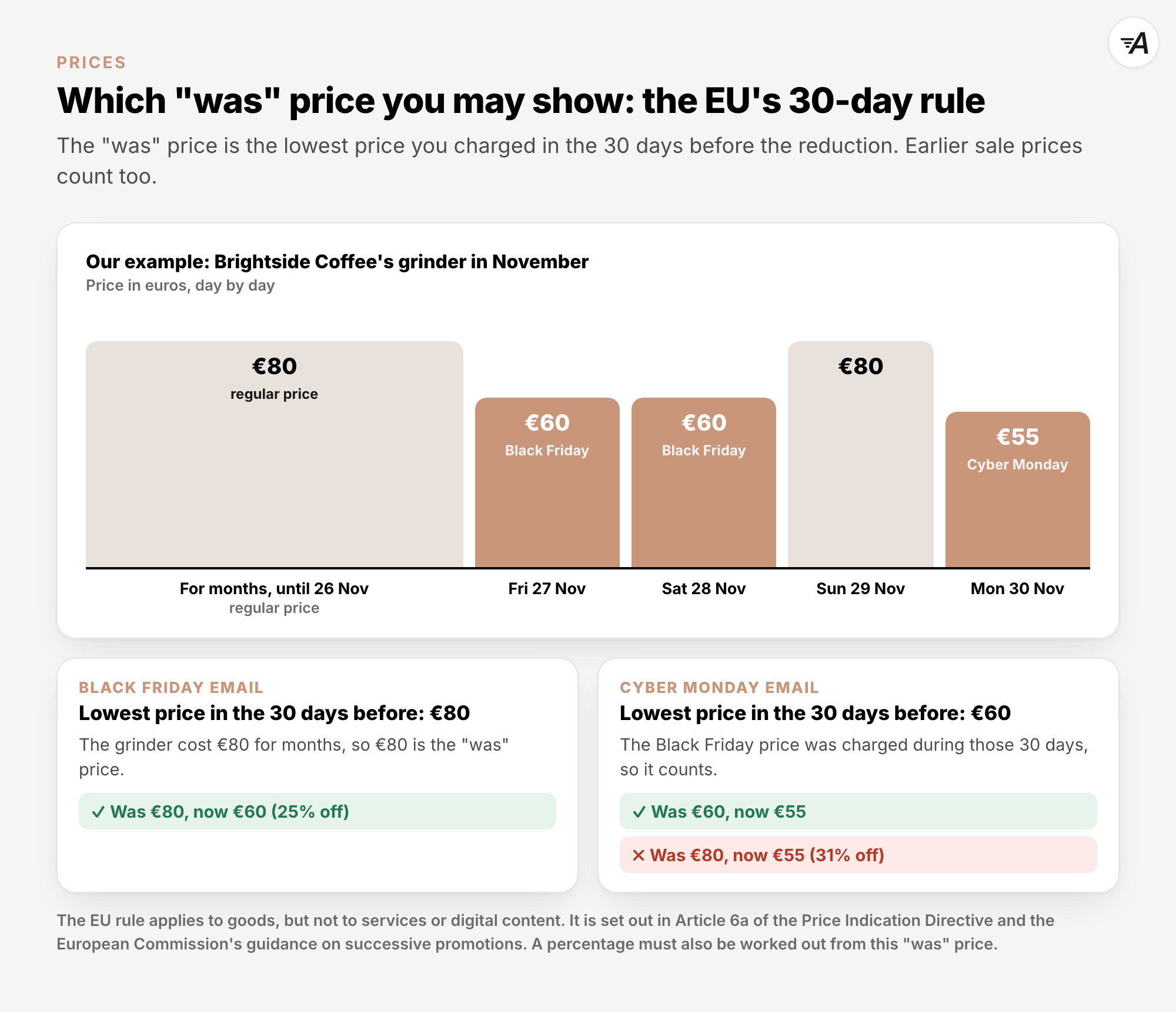
Brightside Coffee's grinder shows how this works:
- The regular price has been €80 for months.
- On Friday 27 and Saturday 28 November, the Black Friday price is €60. "Was €80, now €60" correctly describes 25% off.
- On Sunday 29 November, the price returns to €80.
- On Cyber Monday, 30 November, the price becomes €55. The lowest price in the previous 30 days is now €60. The comparison is "Was €60, now €55", rather than "Was €80, now €55 (31% off)".
The timeline shows why the Black Friday price becomes the prior price for Cyber Monday.
National authorities checked the websites of 314 online traders during Black Friday and Cyber Monday sales. They found that 30% "referenced discounts incorrectly". European Commission, 26 March 2026
Article 6a does not cover a clearly presented comparison with a recommended retail price (RRP) or another trader's price. The UCPD still applies, so the comparison must be clear and not misleading. If readers could take it for a reduction of your own price, Article 6a can apply too. Section 7 explains a proposed change. Commission guidance
In the US, a former price must be genuine: a price you offered openly and regularly, in the recent past, for a reasonably long period. The FTC's guide does not set a fixed number of days. Briefly raising a price to create a discount can lead to a "fictitious" comparison. 16 CFR 233.1
In the UK, the CMA says advertised prices must include delivery fees that every buyer must pay. We read this as applying to prices in sale emails, although the letter does not mention a case involving email. CMA open letter, 2 November 2026
3. Deadlines, countdowns and "while stocks last"
The EU's list of banned practices includes "Falsely stating that a product will only be available for a very limited time". The ban also covers false claims that particular terms are available for a very limited time. It applies when these claims aim to push people into an immediate decision, without enough time to make an informed choice. In the UK, the same rule applies for any "limited time". EU item 7, UK paragraph 7
On 14 October 2026, the CMA fined Wayfair £4.8 million and Appliances Direct £1.2 million. Wayfair's website used time-limited offers with countdown timers, but many products were still available at the same price or lower after the deadline. Appliances Direct's countdown banners offered discounts for a limited time, but the same discount codes appeared again over many days. Its fine also covered adding paid extras to orders automatically. CMA announcement
Emma Sleep admitted that it broke consumer law "by using misleading countdown timers, and false ‘high demand’ messages and ‘discount’ claims". A High Court order dated 22 May 2026 confirmed this. Under its commitments, it cannot use ‘limited time’ sales or discounts "where substantially similar deals continue after the deadline passes". CMA, 28 May 2026
The Australian Competition and Consumer Commission (ACCC) is checking for offers that continue after their deadlines and for false claims about low stock. ACCC warning
In the US, an FTC staff report describes countdowns that have no basis and disappear or reset, but the report is not a rule. Bringing Dark Patterns to Light
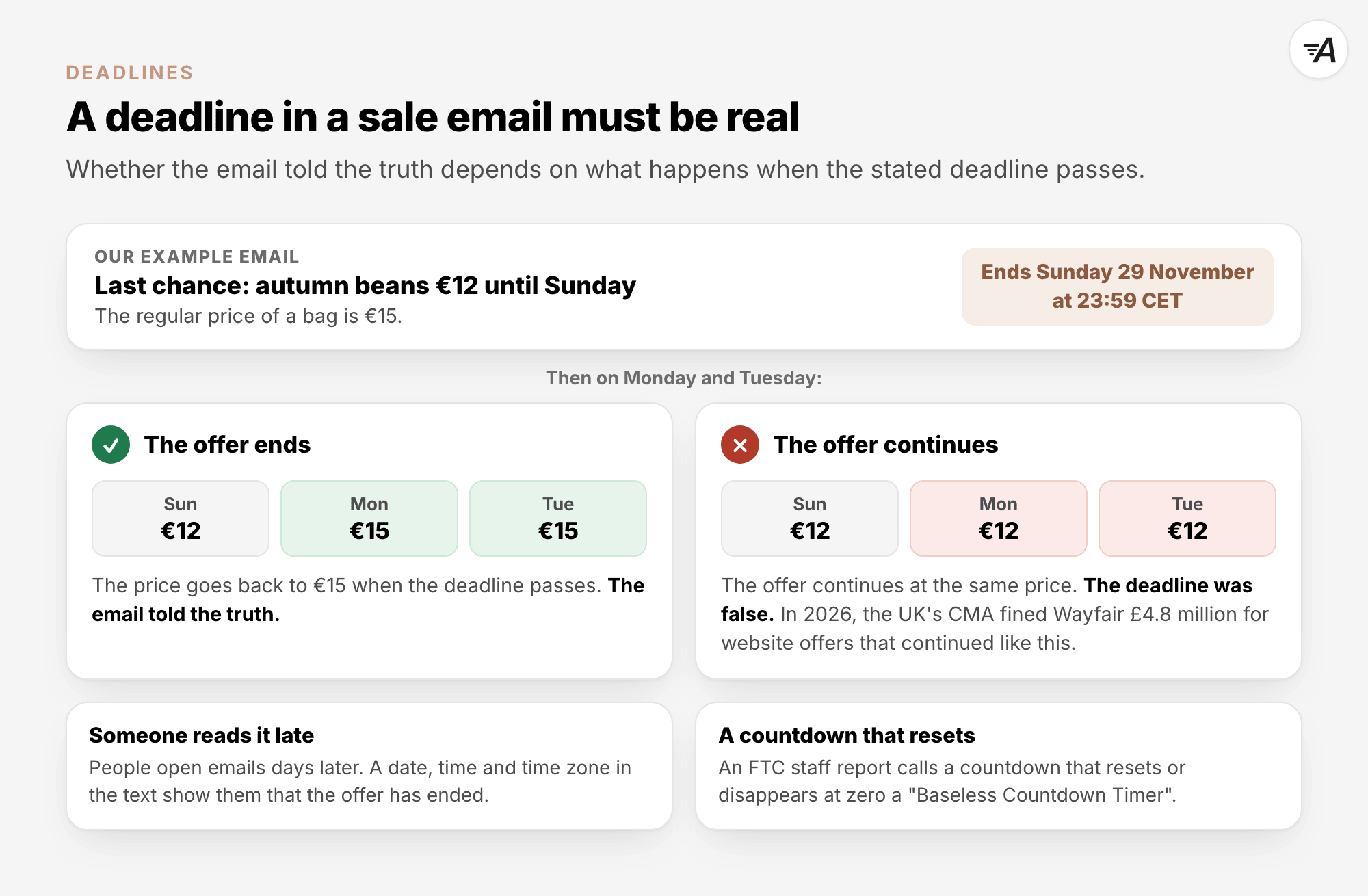
For email, our understanding is that your deadline must match what happens:
- If the sale ends on Sunday, end it on Sunday, because extending it can make an earlier "last chance" claim false.
- People may open emails days later, so include the date and time zone in the text: "Ends Sunday 29 November at 23:59 CET".
- Stock claims must match your records. Section 5 of Email Subject Lines Explained explains why these are statements of fact.
Section 8 explains how an AcelleMail campaign can continue sending after a deadline.
The diagram compares a genuine deadline with an offer that continues afterwards.
4. "Free" gifts and the conditions behind them
In the EU and UK, you may call an item free only if the customer pays nothing for it, apart from unavoidable costs such as replying to the offer, collecting the item or having it delivered. A free item that comes with a purchase can still be allowed, as the next paragraph explains. EU item 20, UK paragraph 23
The Commission's guidance says the ban "does not prevent traders from using the claim ‘free’ in conditional purchase promotions" if these conditions are met:
- Customers must understand all the costs they have to pay.
- The quality and composition of the items they buy must stay the same.
- The price of those items must not rise to cover the free item's cost.
Buy-one-get-one-free offers are allowed under these conditions. UCPD guidance, section 3.4
The EU's e-Commerce Directive adds a rule in Article 6(c). Conditions for promotional offers, such as discounts, bonus items and gifts, must be easy to find and set out clearly, with no doubt about their meaning.
The FTC's guide says conditions should be clearly shown at the start of a free offer. An asterisk pointing to a footnote is not enough. 16 CFR 251.1
The same ACCC warning advises against relying on fine print to limit a headline's claim.
A US case shows why it matters where these conditions appear in an email. Shoppers sued Ulta over marketing emails sent from about November 2023 to August 2025. According to their complaint, the subject lines promised "free" gifts and percentage discounts. The conditions, such as a minimum spend or brands left out of the discount, appeared in the body of the emails. One subject line read "Don't miss 10% off your purchase".
On 15 September 2026, a federal court in Indiana let the claim about misleading subject lines go ahead. It has not decided whether the emails were misleading: "Whether any reasonable jury could find that Ulta's emails are misleading is a question for another day." Under Indiana's law, a person can claim $500 for each email that breaks it, without having to prove a loss. The court's order
Email Subject Lines Explained, section 5, covers Washington's law and the Old Navy case.
Keep an offer and its main condition in one line, for example "Free tote bag with orders over €40". If the subject line has no room for the condition, put it in the preheader, the preview line that many mail apps show after the subject. Readers whose mail app shows it can then see the condition before they open the email.
5. Reviews, star ratings and other social proof
In the US, the FTC's 2024 rule on reviews bans a business from writing, creating or selling a review that misrepresents who wrote it. This includes reviews that misrepresent whether the reviewer used the product or what their experience was like. The rule also bans rewards that depend on a review expressing a particular opinion, positive or negative. 16 CFR Part 465
Inviting only happy customers to post reviews may be deceptive if it makes the published reviews much more positive than they would otherwise be. You may invite all recent buyers, even if you hope for positive reviews. This matters when you email review requests. 16 CFR 255.2, Example 11
EU rules require reasonable, proportionate checks before you claim that reviews come from actual buyers or users. They also ban fake reviews and misrepresenting reviews or endorsements. EU items 23b and 23c
The UK bans submitting or commissioning fake reviews or reviews that hide an incentive. UK paragraph 13
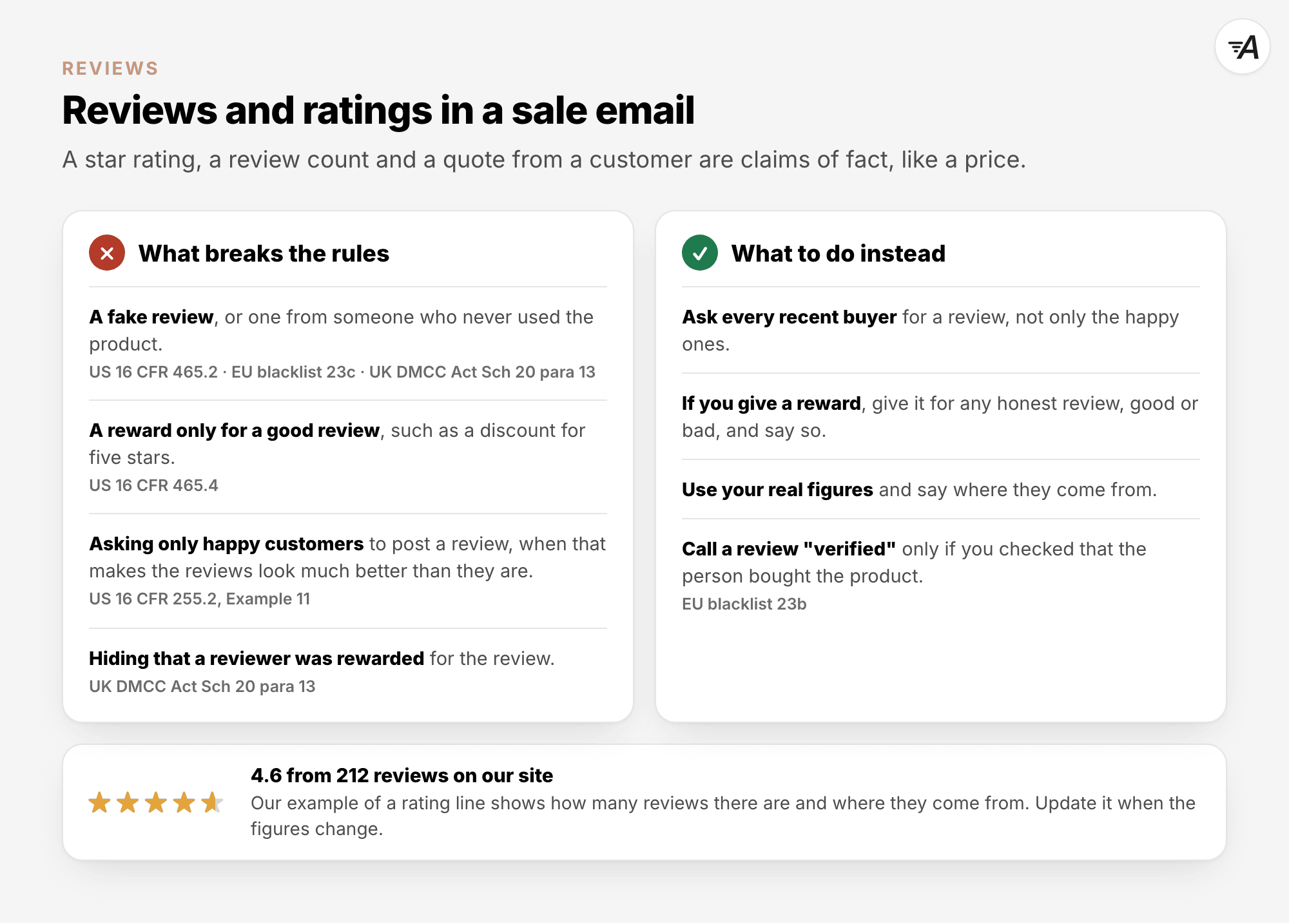
Our reading is that ratings, review counts, verified labels and customer counts are factual claims too. Use current numbers and say where they come from, for example "4.6 from 212 reviews on our site".
The diagram shows review practices to avoid and what to do instead.
In AcelleMail
The email builder's Rating and Social proof blocks start with sample numbers, and some of their layouts show sample reviews. Their ready-made styles also include sample numbers, sometimes with the name of a review site. Replace every number, name and review with your own, or delete the block. Then send yourself a test email and check that the stars and numbers in the inbox match your real rating. AcelleMail does not collect or check reviews, so the numbers are whatever you type.
6. Green claims: "eco-friendly" and "climate neutral"
EU countries must apply the rules on green claims in Directive (EU) 2024/825 from 27 September 2026. Other countries have their own rules, which this guide does not cover.
A generic claim such as "eco-friendly" is banned unless you can show "recognised excellent environmental performance relevant to the claim". This means meeting the rules of the EU Ecolabel or an officially recognised ecolabel scheme (EN ISO 14024 type I). You can also meet the requirement through top performance under other EU law. Your own view that a product is green does not count. Directive (EU) 2024/825
The directive treats "climate-friendly packaging" differently from "100 % of energy used to produce this packaging comes from renewable sources". The first claim is generic, while the second is specific. If you explain a green claim with specific details like these, the details must be clear and easy to see in the same email, and they must be true. Directive (EU) 2024/825
The EU also bans claims such as "climate neutral" when they rest on offsetting, which means balancing a product's emissions with cuts or removals outside its own supply chain. Proof of the offsetting does not change this. Such claims are allowed only when they are based on the product's own environmental impact over its whole life.
A sustainability label must be based on a certification scheme or set up by public authorities. EU items 4a, 4c and 2a
7. What may change: the EU's Digital Fairness Act proposal
The European Commission published this proposal on 11 November 2026. It would replace the UCPD and now goes to the European Parliament and Council. It is not law, and its wording may change. If adopted as proposed, it would enter into force 20 days after its publication in the EU's Official Journal, and its rules would start to apply only 12 months after that. Proposal
It would require an offer said to be available for only a very limited time to state how long it lasts. It would also ban false claims about availability or popularity. Another target is shaming people who say no. One of the Commission's examples is an unsubscribe button that says "I don't like good deals". Q&A
Its notification rule covers false suggestions that someone has contacted you or that something needs your attention. In our reading, fake "Re:" or "Action needed" emails may fall within this rule.
Comparisons with a reference price, such as a struck-out RRP, would be allowed only if a clearly identified competitor currently charges that price. A struck-out RRP on its own, as in "RRP €120, now €80", would then no longer be allowed in the EU. The proposal says this does not change the rules for your own price reductions, which section 2 covers. Proposed rules, Proposal, recital 105
The proposal does not ban countdowns as such, and neither "countdown" nor "timer" appears in it or its annexes.
You can follow much of this today: give every deadline a date and a time zone, and label your unsubscribe link "Unsubscribe". Email Consent Explained, section 6, covers unsubscribe rules.
8. Your sale emails in AcelleMail
On the Setup step, check Email subject and From name, then review the design and Preheader text on the Template step. Inbox preview shows the sender, subject and preheader together. Email Subject Lines Explained shows these screens.
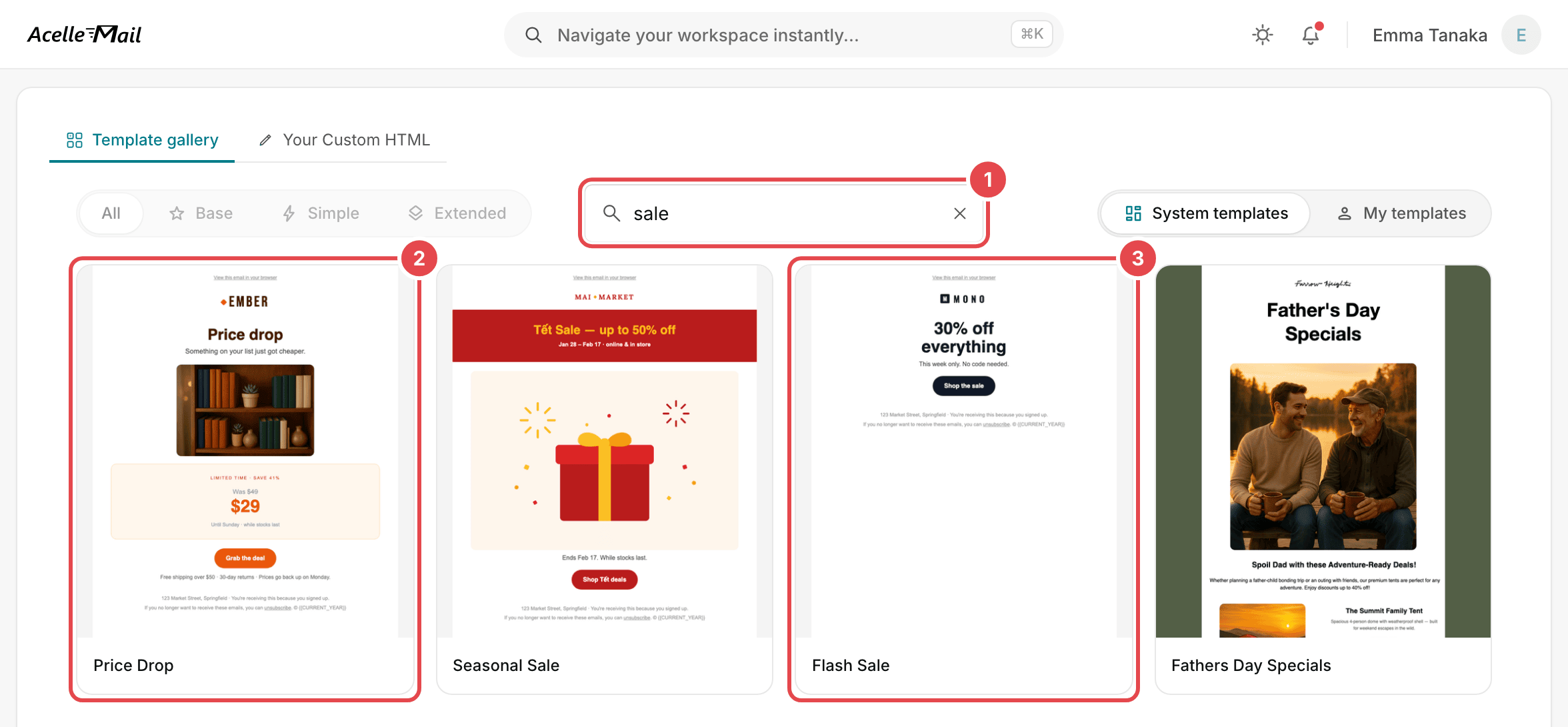
The template gallery has a search box and tabs labelled All, Base, Simple and Extended. Searching for "sale" (1) shows designs such as Price Drop (2), Flash Sale (3), Seasonal Sale and Sitewide sale.
The text in these designs is sample content. Depending on the design, it includes a struck-out "was" price with a percentage, a deadline, "while stocks last", a discount on everything and a sample postal address. Replace every price, percentage, date, stock statement and address with your own details, or delete it.
The screenshot shows the gallery after a search for "sale", with two of the sale designs marked.
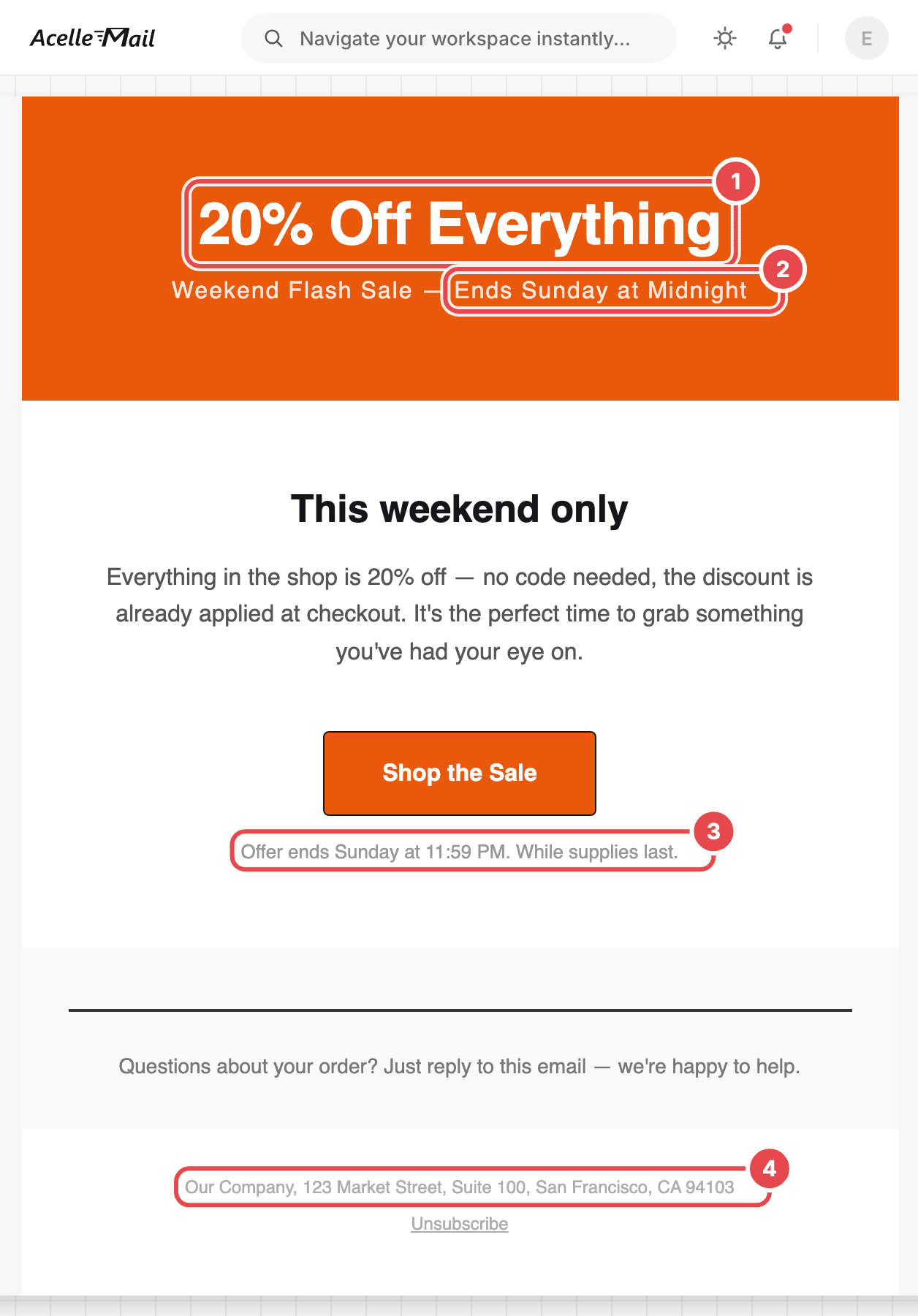
In the second screenshot, a sale design from a demo campaign is open in the builder. Check each marked claim:
- The discount (1): Say "20% Off Everything" only if every product is 20% off. If some products are left out, change the headline, for example to "20% off all coffee beans". For goods sold in the EU, your shop must also show each product's prior price.
- The deadline (2): "Ends Sunday at Midnight" does not say which Sunday or in which time zone. Add the date and the time zone.
- The small print (3): "Offer ends Sunday at 11:59 PM. While supplies last." The end time must match the header, which says midnight. "While supplies last" is true only if stock can run out.
- The footer (4): Replace the sample address with your real postal address. AcelleMail has no merge tag for it, so type it in. Email Consent Explained explains when a postal address is required.
On the Schedule step, the sending hours option Only during the hours below says: "Sending pauses outside these hours and resumes at the next opening." Nothing is cancelled, so a campaign can still be sending after your deadline. Email Timing Explained, section 8, explains this behaviour.
Schedule the campaign well before the deadline, and pause it if it is still sending when the offer ends. To pause it, open the campaign list, click the arrow next to the campaign's View button and choose Pause.
The sale designs include sample "was" prices, but the email builder has no dedicated "was" price block and no countdown block. AcelleMail keeps no price history, does not collect reviews and cannot check your claims.
On the Confirm step, use Send test email and read the email on a phone too. How to Send Email Marketing That Works provides the full checklist.
9. Common mistakes
| What you see | Why it is a problem | What to do |
|---|---|---|
| You show "Was €80", but €80 was not your lowest price in the previous 30 days, or you charged it only briefly. | For goods, the EU rule uses the lowest price of the previous 30 days. In the US, a former price must be genuine and regular. | For EU goods, use the 30-day lowest price. In the US, use a price you offered openly and regularly. |
| You compare the Cyber Monday price with the pre-Black Friday price. | Earlier promotional prices count under the EU rule. | Include promotional prices when checking the previous 30 days. |
| You say "Ends tonight", but the sale continues. | False deadlines are banned in the EU and UK. | Honour the deadline or leave out the claim. |
| You say "Ends Sunday" without a date or time zone. | People who read the email later cannot tell whether the offer is still running. | Write the date, time and time zone. |
| You promise a free gift but hide the minimum spend. | The condition changes what the headline promises. | Put the main condition beside the offer or in the preheader. |
| You leave sample numbers or reviews in a design. | They can become false claims or fake reviews. | Replace or delete every sample. |
| You ask for reviews only from happy customers. | In the US, review gating may be deceptive if it makes the published reviews much more positive. | Invite all recent buyers. |
| You use "Eco-friendly" for EU customers without recognised proof. | Generic green claims require recognised excellent environmental performance. | Give a specific fact you can prove in the same email. |
Summary
- For every sale claim, check whether it is true, whether you can prove it and whether its conditions appear beside it.
- For EU goods, use the lowest price in the previous 30 days, including promotions. In an email with a general discount, such as "20% off everything", you can leave the previous prices to your shop.
- In the US, former prices must be genuine and regular. In the UK, the CMA says advertised prices must include the delivery fees every buyer pays, and we read this as covering sale emails.
- Honour deadlines and write the date, time and time zone. Stock claims must match your records.
- In the EU and UK, call an item free only if the reader pays nothing for it beyond unavoidable costs such as delivery. A free gift with a purchase is allowed under the conditions in section 4. Put the conditions beside the offer, not in a footnote.
- Reviews must be genuine. In the US, rewards must not depend on a particular opinion. Do not ask only happy customers for reviews, and replace sample figures.
- In the EU, generic green claims require recognised excellent environmental performance. Product claims of climate neutrality based on offsets are banned.
- The Digital Fairness Act remains a proposal, and you can already use many of its suggested practices in your emails.
- In AcelleMail, replace sample claims and check Inbox preview and a test email. Pause sending when an offer expires.
Terms used here are defined in the Email Marketing Glossary.
0 comments
No comments yet — be the first to share a tip or question.